Is Your Child's Screen Time Out of Control?
If you are a parent in Pakistan, chances are you have asked yourself this question more than once. A recent study found that Pakistani children between the ages of 5 and 14 spend an average of 4 to 6 hours daily on mobile phones and tablets — much of it on YouTube, TikTok, and mobile games.
The good news? There is a surprisingly simple and affordable solution already used by thousands of Pakistani families: a whiteboard at home.
---
The Whiteboard Effect — What Research Says
Studies on child development consistently show that children who write and draw by hand:
| Skill | Screen vs Whiteboard |
|---|---|
| Information retention | 40% better with handwriting |
| Creative thinking | Significantly stronger with drawing |
| Focus and attention | Longer without digital distractions |
| Planning and organisation | More effective with visual boards |
| Confidence | Higher through physical expression |
When a child writes on a whiteboard, they are actively engaging their brain in a way that passively watching a screen simply cannot match. The physical act of writing, drawing, erasing and rewriting builds neural pathways that form the foundation of strong academic performance.
---
Why Pakistani Families Are Choosing Whiteboards
Across Karachi, Lahore and Islamabad, parents are discovering that placing a whiteboard in their child's bedroom or study room creates an immediate shift in behaviour.
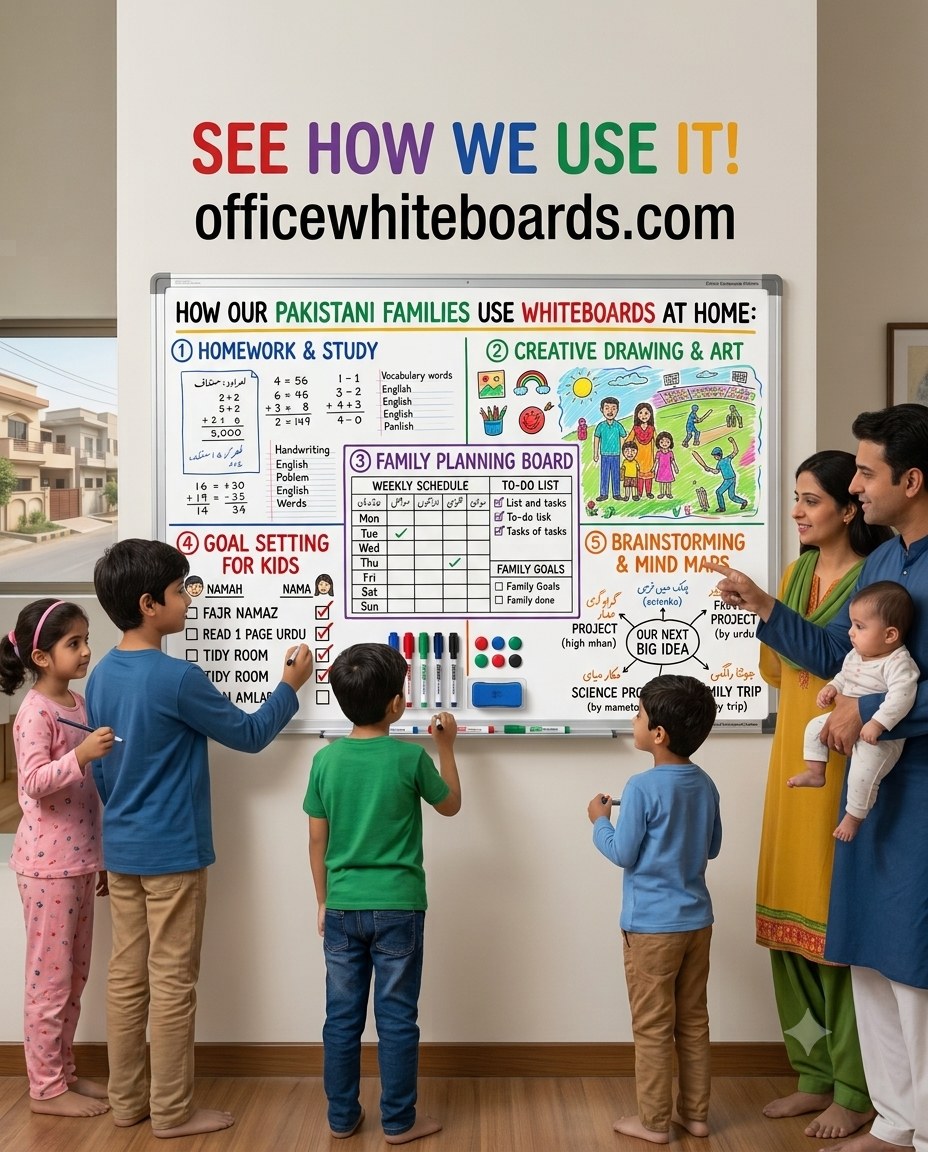
Here is what families are using whiteboards for at home:
1. Homework and Study
Children who do their maths, Urdu and English practice on a whiteboard make fewer mistakes and retain more. The ability to write large, erase quickly and try again removes the frustration that comes with paper — especially for younger children still developing their writing skills.
Ideal size for study: 2×3 ft whiteboard mounted at eye level — Rs 3,960 from OfficeWhiteboards.com
2. Creative Drawing and Art
Children are natural artists. Give them a large blank surface and they will fill it with drawings, stories, comic strips and imaginative worlds — none of which require a phone or tablet. This kind of unstructured creative play is essential for emotional development.
Ideal size for art: 3×4 ft whiteboard — gives enough space for real creative expression — Rs 7,040
3. Family Planning Board
A whiteboard in the living room or kitchen becomes a shared family space — weekly schedule, chores list, grocery reminders, upcoming events. When children see their responsibilities displayed visibly, they become more accountable and independent.
Ideal size for family use: 3×4 ft or 4×6 ft — visible from across the room
4. Goal Setting for Kids
Let your child write their daily goals on the whiteboard every morning and tick them off as they complete them. Fajr Namaz, reading one page of Quran, finishing homework, tidying their room — seeing these goals in front of them builds the habit of discipline and gives a sense of achievement that no mobile game can replicate.
Tip: Give your child full ownership of their whiteboard. Let them decide what goes on it. This sense of ownership increases engagement dramatically.
5. Brainstorming and Mind Maps
Older children and teenagers can use a whiteboard for project planning, exam revision, mind mapping and creative writing outlines. This is particularly powerful for O-Level and Matric students who need to organise large amounts of content.
---
How to Transition Away from Screens — A Practical Plan
The key is not to take the phone away cold turkey. That creates conflict and resistance. Instead, replace screen time gradually with something more engaging:
Week 1 — Introduce the whiteboard
Place the whiteboard in their room or study area. Let them draw and write freely with no pressure. Buy colourful markers — red, blue, green, black. The novelty alone will attract them.
Week 2 — Connect it to routine
Start using it for homework and daily goals. Make it a habit: every morning write 3 goals, every evening review what was done.
Week 3 — Family involvement
Create a family planning board together. Let children contribute to the weekly schedule. When they feel heard and involved, they are less likely to retreat to screens.
Week 4 — Screen time rules
Now that you have an alternative activity established, introduce screen time limits — for example, no phone before homework is complete on the whiteboard. The whiteboard becomes the gateway to phone time, not a replacement. This works better than simply restricting access.
---
Which Whiteboard Is Right for Your Home?
| Use case | Size | Price |
|---|---|---|
| Small bedroom, young child | 1×1.5 ft | Rs 1,340 |
| Study room, primary school | 2×3 ft | Rs 3,960 |
| Shared family board | 3×4 ft | Rs 7,040 |
| Teen study and revision | 4×6 ft | Rs 12,760 |
| Double-sided, maximum use | Double-sided board | Rs 1,980 |
| Young learner (specially designed) | Kids Learning Board | Rs 6,200 |
All boards come with:
---
Special Offer This Month
For families ordering this month, OfficeWhiteboards.com is offering:
---
Order Today — It Is Simple
Browse all home and kids whiteboards:
WhatsApp order (fastest):
We deliver across Pakistan:
| NTN: 7194942-2 | Proper invoice provided with every order. |
|---|
---
Final Thought for Parents
The question is not whether screens are bad — they are part of modern life and your child will need digital skills. The question is balance. A whiteboard at home does not fight technology. It simply gives your child something more tactile, more creative and more rewarding to reach for first.
One whiteboard. One wall. One small change that could make a meaningful difference in how your child learns, thinks and grows.